
As an Amazon Associate, I earn from qualifying purchases. This post may contain affiliate links. Read our full disclosure.
Google Pixel 9a vs Google Pixel 10: 5 Reasons the Mid-Range King Might Actually Beat the Flagship.
In the ever-evolving landscape of Silicon Valley innovation, Google has firmly established itself as a titan of mobile photography and artificial intelligence. For tech enthusiasts and everyday users in the United States, the choice between the mid-range “a” series and the flagship lineup has never been more compelling.
As we look at the Google Pixel 9a vs Google Pixel 10, we are witnessing a clash between ultimate value and cutting-edge silicon engineering. At Gadget Info, we have extensively analysed the hardware trajectories, software roadmaps, and early performance benchmarks to help you decide which Google powerhouse deserves a spot in your pocket.
Price Summary of Google Pixel 9a vs Google Pixel 10
| Google Smart Phone Model | Price of 128GB | Price of 256GB |
| Google Pixel 9a (8GB) | $469 | $549.99 |
| Google Pixel 10 (12GB) | $599 | $749 |

Google Pixel 9a vs Google Pixel 10: The Strategic Overview
The Google Pixel 9a serves as the final refinement of the “Tensor-Samsung” era, offering flagship-level software at a price point that undercuts the competition by hundreds of dollars.
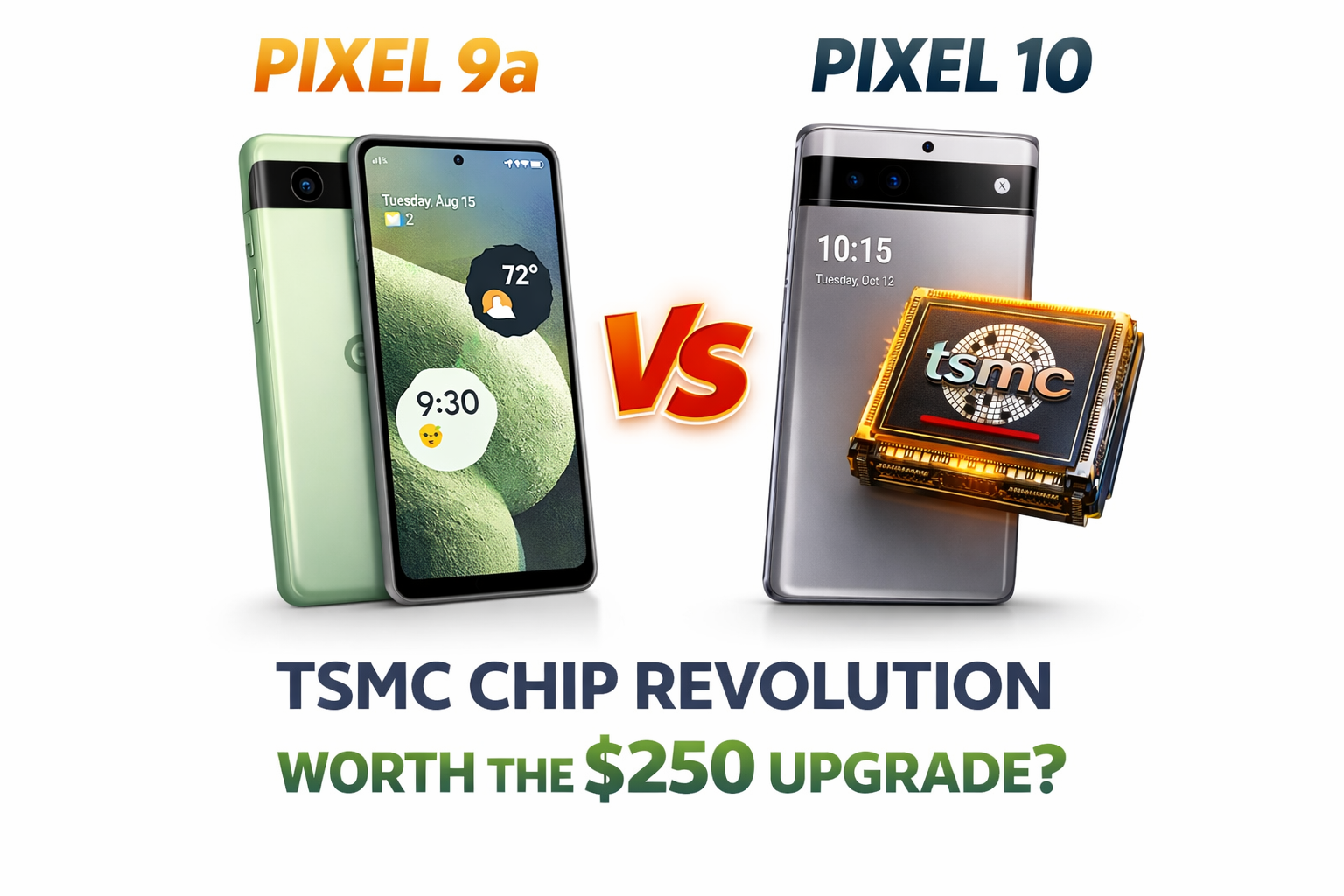
Conversely, the Google Pixel 10 represents a historic pivot for Google. It is the first device to feature the Tensor G5, a chip manufactured by TSMC (the same foundry that produces Apple’s world-leading processors).
This transition marks a “before and after” moment for Pixel hardware, promising better thermal management, superior battery efficiency, and a significant leap in AI processing power.
1. Design and Build Quality: Minimalism vs Premium Elegance
The Google Pixel 9a takes a bold step away from the iconic “Camera Bar” that defined Pixels for years. Instead, it opts for a nearly flush camera island, reminiscent of the vintage Pixel 3a. Its chassis is a blend of an alloy frame and a durable thermoformed plastic back.
The Google Pixel 10, being the flagship, sticks to the “Pro” aesthetic with a more pronounced camera bar, a glass-on-glass sandwich design protected by Gorilla Glass Victus 2, and a refined satin-finish metal frame.
Comparative Table: Design & Build of Google Pixel 9a vs Google Pixel 10
| Feature | Google Pixel 9a | Google Pixel 10 |
| Material | Alloy Frame / Plastic Back | Aluminum Frame / Glass Back |
| Glass Protection | Gorilla Glass 3 | Gorilla Glass Victus 2 |
| Dimensions | 154.7 x 73.3 x 8.9 mm | 152.8 x 72.0 x 8.6 mm |
| Weight | 185.9g | 204.0g |
| IP Rating | IP68 (Water/Dust Resistant) | IP68 (Water/Dust Resistant) |
| Available Colours | Iris, Peony, Porcelain, Obsidian | Indigo, Frost, Lemongrass, Obsidian |

2. Display: Smoothness Meets Brightness
The US market demands high-visibility screens for outdoor use. The Pixel 9a brings a 6.3-inch Actua display that is remarkably bright for its class. However, the Pixel 10 pulls ahead with Super Actua technology, offering higher peak brightness and better power efficiency thanks to its LTPO panel.
Comparative Table: Display Technology of Google Pixel 9a vs Google Pixel 10
| Feature | Google Pixel 9a | Google Pixel 10 |
| Display Type | OLED (Actua) | LTPO OLED (Super Actua) |
| Size | 6.3 Inches | 6.3 Inches |
| Resolution | 1080 x 2424 (422 PPI) | 1280 x 2856 (495 PPI) |
| Refresh Rate | 60–120Hz | 1–120Hz (Adaptive) |
| Peak Brightness | 2,700 Nits | 3,000+ Nits |
3. Performance: The TSMC Revolution
This is where the Google Pixel 9a vs Google Pixel 10 debate gets intense. The 9a uses the Tensor G4—a capable chip but one that still shares DNA with Samsung’s Exynos architecture.
The Pixel 10’s Tensor G5 is Google’s first truly custom-designed chip. By switching to TSMC’s 3nm process, Google has addressed the two biggest complaints from American users: overheating and thermal throttling. The Pixel 10 isn’t just faster; it’s smarter and cooler.

Comparative Table: Performance & Storage of Google Pixel 9a vs Google Pixel 10
| Component | Google Pixel 9a | Google Pixel 10 |
| Chipset | Google Tensor G4 | Google Tensor G5 (TSMC) |
| RAM | 8GB LPDDR5X | 12GB LPDDR5X |
| Internal Storage | 128GB / 256GB | 128GB / 256GB / 512GB |
| Storage Type | UFS 3.1 | UFS 4.0 (Faster Data Access) |
| Software Support | 7 Years of Updates | 7 Years of Updates |
4. Camera Capabilities: Dual vs Triple Threat
Google’s “A-series” has always punched above its weight. The Pixel 9a inherits the 48MP sensor from the high-end Pixel Fold, delivering incredible detail. However, the Pixel 10 remains the photographer’s choice, introducing a dedicated 5x Telephoto lens to the base flagship model for the first time.
Comparative Table: Camera Specifications of Google Pixel 9a vs Google Pixel 10
| Camera | Google Pixel 9a | Google Pixel 10 |
| Main Sensor | 48MP (f/1.7, OIS) | 50MP (f/1.68, OIS) |
| Ultra-Wide | 13MP (120° FOV) | 48MP (123° FOV, Macro) |
| Telephoto | None (8x Super Res Zoom) | 10.8MP (5x Optical Zoom) |
| Front Camera | 13MP (f/2.2) | 10.5MP (Dual PD Autofocus) |
| Video Features | 4K @ 60fps, Night Sight | 4K @ 60fps, Video Boost |
5. Battery and Charging: Longevity vs Speed
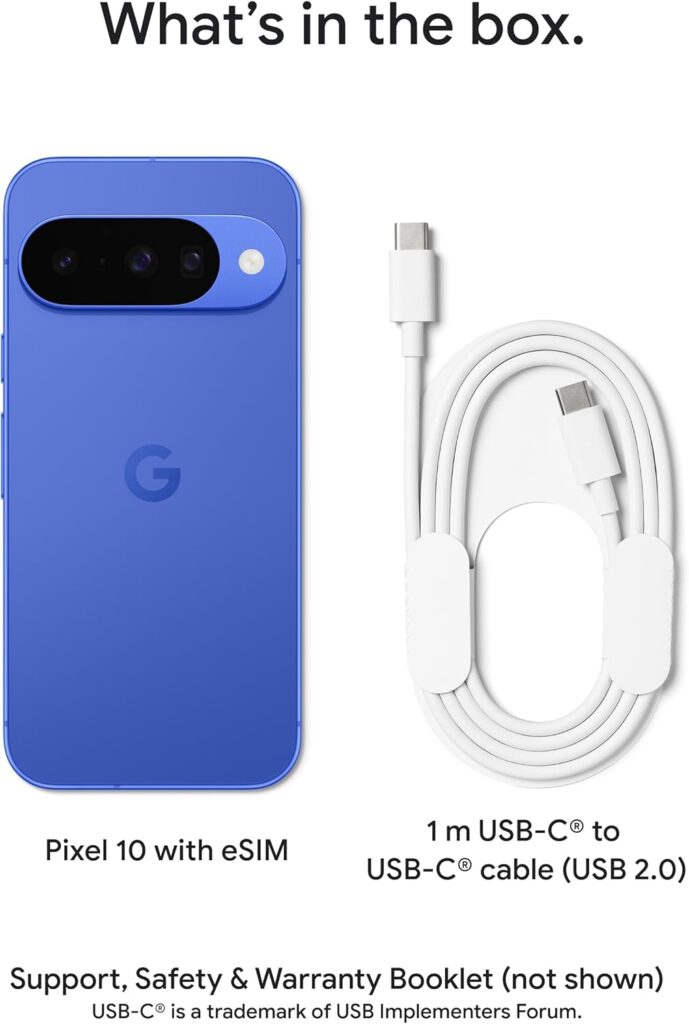
Interestingly, the Pixel 9a actually houses a slightly larger physical battery (5100mAh) than the Pixel 10. However, the Pixel 10 counters with faster 30W wired charging and the inclusion of Qi2 magnetic wireless charging, making it compatible with a new world of magnetic accessories popular in the USA.
Comparative Table: Battery & Connectivity of Google Pixel 9a vs Google Pixel 10
| Feature | Google Pixel 9a | Google Pixel 10 |
| Battery Capacity | 5,100 mAh | 4,970 mAh |
| Wired Charging | 23W | 30W |
| Wireless Charging | 7.5W (Standard Qi) | 15W (Qi2 Magnetic) |
| Wi-Fi | Wi-Fi 6E | Wi-Fi 7 |
| Bluetooth | 5.3 | 6.0 |
Pros and Cons of Google Pixel 9a vs Google Pixel 10
Google Pixel 9a
- Pros:
- Unbeatable value-for-money at ~$499.
- Large 5,100mAh battery provides legendary endurance.
- Minimalist, flush camera design prevents “wobble” on tables.
- Access to premium AI tools like Magic Editor and Gemini.
- Cons:
- Older Gorilla Glass 3 is prone to scratches.
- Wired charging is painfully slow by 2026 standards.
- No dedicated telephoto lens.
Google Pixel 10
- Pros:
- New Tensor G5 chip offers superior efficiency and thermals.
- Stunning 5x optical zoom for versatile photography.
- Qi2 magnetic charging support.
- Brighter, more adaptive Super Actua display.
- Cons:
- Higher entry price (~$799).
- Battery capacity is technically smaller than the 9a.
Pricing and Availability in America of Google Pixel 9a vs Google Pixel 10
- Google Pixel 9a: Launched at $499. It is widely available at carriers like Verizon, T-Mobile, and AT&T, often with “Free with Trade-in” deals.
- Google Pixel 10: Launched at $799. Positioned as the premium flagship choice for those who want the latest TSMC silicon and a full camera suite.
Frequently Asked Questions (FAQs) of Google Pixel 9a vs Google Pixel 10
- Does the Pixel 9a have the same chip as the Pixel 10? No, the Pixel 9a uses the Tensor G4, while the Pixel 10 features the more advanced Tensor G5.
- Is the Pixel 10 better for gaming than the 9a? Yes, the Tensor G5 in the Pixel 10 offers better sustained performance and thermal management.
- Does Pixel 9a support wireless charging? Yes, but at a slower 7.5W speed.
- What is the “a” in Pixel 9a? It stands for Google’s affordable line, providing flagship software at a lower hardware cost.
- Will Pixel 10 get 7 years of updates? Yes, Google has committed to 7 years of OS and security updates for both models.
- Does the Pixel 10 have a headphone jack? No, both phones use USB-C for audio.
- Is the Pixel 9a waterproof? It has an IP68 rating, meaning it can withstand immersion in shallow water.
- Which phone has a better camera? The Pixel 10, thanks to its 5x optical zoom lens and Video Boost features.
- What is the main difference in the Google Pixel 9a vs Google Pixel 10 comparison? The primary differences are the processor (G4 vs G5), the extra telephoto lens on the 10, and the build materials.
- Does Pixel 10 support MagSafe? It supports Qi2, which is the industry standard compatible with magnetic accessories.
- Is the Pixel 9a screen 120Hz? Yes, it supports an adaptive 60-120Hz refresh rate.
- Can I use my old Pixel 8a case on the 9a? No, the dimensions and camera designs are significantly different.
- Is the Tensor G5 really made by TSMC? Yes, all reports confirm Google shifted manufacturing to TSMC for the Pixel 10 series.
- How much storage does the Pixel 10 have? It starts at 128GB and goes up to 512GB.
- Does the Pixel 9a have Face Unlock? Yes, it supports Class 3 Biometric Face Unlock for secure apps.
- Is the Pixel 10 worth the extra $300? If you value zoom photography and long-term efficiency, yes. For basic use, the 9a is better value.
- What is Gemini AI? It is Google’s next-gen AI assistant integrated deeply into both devices.
- Which phone is lighter? The Pixel 9a (185.9g) is lighter than the Pixel 10 (204g).
- Does the 9a have an eSIM? Yes, both phones support Nano SIM and eSIM.
- Is there a Pixel 10a? The Pixel 10a is expected to launch in early 2026, following the release of the main Pixel 10.
My Final Thoughts: Which One Should You Buy?
At Gadget Info, our recommendation is simple. If you are a student or a budget-conscious professional in the USA, the Google Pixel 9a offers 90% of the flagship experience for 60% of the price. It is the king of mid-range smartphones.
However, if you are a “power user” who records a lot of video, plays mobile games, or simply wants the most future-proof hardware Google has ever made, the Google Pixel 10 is the clear winner. The move to TSMC silicon with the Tensor G5 is a game-changer that makes the Pixel 10 a true rival to the latest iPhones and Galaxies.
Check the latest prices here:

Kaushik Chatterjee is a dedicated tech enthusiast and the founder of GadgetInfo.net. With 5 years of experience tracking the consumer electronics market, specializes in breaking down complex technical specifications into easy-to-understand insights for everyday users.
From the latest smartphone launches to deep dives into PC hardware, our mission is to help readers make informed buying decisions in an ever-evolving digital world.
We are proud to announce that Gadget Info is officially recognized as a startup by the Department for Promotion of Industry and Internal Trade (DPIIT), Government of India.
Our official BHASKAR ID (Bharat Startup Knowledge Access Registry) is: IN-0126-9371SS
This recognition underscores our commitment to innovation, professional integrity, and our role within India’s growing digital ecosystem.
You can write us at admin@gadgetinfo.net