
As an Amazon Associate, I earn from qualifying purchases. This post may contain affiliate links. Read our full disclosure.
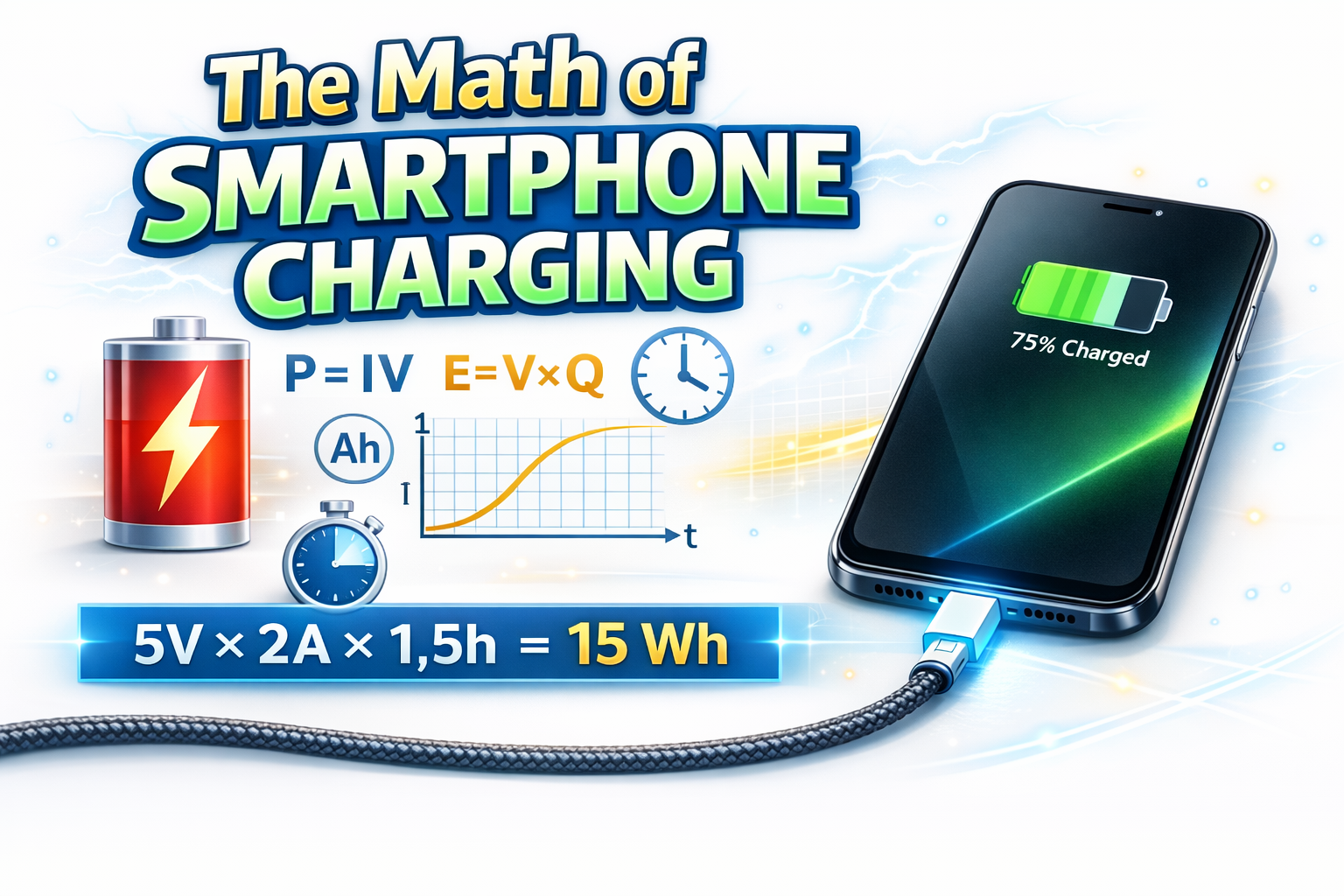
The Math of Smartphone Charging: Why Your 65W Power Bank is Silently Killing Your Battery Life
In the high-speed streets of Mumbai or the tech hubs of Bangalore, time is money. We demand our smartphones to be ready at all times. This has led to the explosion of the ultra-fast power bank market in India. Whether it is a 65W “Super Flash” charger or a 100W massive battery pack, the promise is always the same: Go from 0% to 50% in 15 minutes.
But at Gadget Info, we look deeper. Behind the convenient “quick top-up” lies a complex web of electrochemical stress and thermal strain. Today, we are performing a deep-dive into The Math of Smartphone Charging to explain exactly why that fast power bank might be a “silent killer” for your device’s longevity.
1. The Math of Smartphone Charging: Joule Heating in Mobile Batteries
The primary enemy of any battery is heat. In physics, this is dictated by Joule’s First Law. When you push electricity through a conductor (like your phone’s charging circuit and the battery itself), some of that energy is lost as heat.
Formulae: P_{heat} = I^2* R
Where: ( I^2 = We consider as I’s Square. Like 2’s Square=4, Like 3’s Square=9, Like 5’s Square=25)..etc
- P = Power dissipated as heat (Watts)
- I = Current (Amperes)
- R = Internal Resistance (Omega)
The Math Breakdown:
Imagine your standard charger uses 2A (Amperes). The heat generated is proportional to 2^2 = 4. If you switch to a “Fast” power bank delivering 5A, the heat isn’t just double; it is 5^2 = 25.
Technical Insight: Moving from 2A to 5A increases the current by 2.5x, but the internal heat stress increases by 6.25x. In the context of India’s ambient temperatures, this often pushes the battery into a danger zone.
2. The Math of Smartphone Charging: Lithium-ion Battery Degradation Physics- What Happens Inside?
A smartphone battery isn’t a bucket you fill with water; it’s a delicate chemical sandwich. Lithium-ion battery degradation physics focuses on how ions move between the Anode and Cathode.
When you charge too fast, you trigger Lithium Plating. Instead of the lithium ions neatly intercalating (hiding) inside the graphite anode, they “crash” into the surface and turn into metallic lithium. This creates:
- SEI Layer Growth: A thick “crust” that increases internal resistance ($R$).
- Dendrites: Microscopic spikes that can eventually pierce the separator, causing a fire or a “dead” battery.
Degradation occurs due to side reactions where lithium ions are permanently trapped in the SEI layer instead of intercalating into the anode. This increases internal resistance and depletes the “Lithium Inventory.” Thermal fluctuations further accelerate chemical decomposition, leading to mechanical strain and electrode cracking.
Mathematical Estimation
We can model capacity loss using a simplified power-law equation:
Formulae: C_{loss} = k* t$n
Where: Where: ( t$n = We consider as t- to the power n. Like 2– to the power n, Like 3– to the power n)… etc
- C_{loss} is the capacity loss.
- k is the rate constant (dependent on temperature/SOC).
- t is time.
Calculation:
If a battery has a rate constant k = 0.05 and follows a square-root time dependence (n = 0.5): After 100 days:
C_{loss} = 0.05* Root Over{100} = 0.5% (Answer)
3. The Math of Smartphone Charging: C-Rate Battery Charging Math: Measuring Stress
How do engineers define “fast”? They use the C-rate.
Formulae: {C-rate} = I (Amps) Divided by {Capacity (Ah)}
For a typical Indian smartphone with a 5,000mAh (5Ah) battery:
- 0.5C (Slow): 2.5A current. The battery is happy.
- 1.0C (Fast): 5.0A current. The battery is under stress.
- 2.0C+ (Ultra-Fast): 10.0A+ current. This is where significant damage begins.
Most 65W power banks push the battery well beyond the 1C limit, leading to a much faster Battery cycle life vs charging speed trade-off.
4. The Math of Smartphone Charging: Power Bank Efficiency Calculation- The 3.7V vs 5V Trap
Have you noticed your 10,000mAh power bank never actually gives you two full charges for a 5,000mAh phone? Here is the math:
- Internal Cell Voltage: 3.7V
- Output Voltage (USB): 5V, 9V, 12V
- Conversion Loss: Energy is lost as heat during the “step-up” process.
Formulae: Actual Output (mAh) = (Capacity x 3.7 x n) Divided by (Output Voltage)
Assuming 85% efficiency (n = 0.85):
then According to Formulae (10,000 x 3.7 x 0.85) Divided by 5 = 6,290 mAh
The Fast Charging Penalty: As the wattage increases (e.g., to 65W), efficiency drops further because the power bank components heat up, wasting more of that 10,000mAh as thermal energy rather than battery percentage.
5. The Math of Smartphone Charging: Thermal Throttling in Fast Charging: The Software Safeguard
To prevent your phone from becoming a paperweight, manufacturers implement Thermal Throttling in fast charging.
When the internal sensors detect the battery temperature crossing 43 Degree C to 43 Degree C, the USB-PD (Power Delivery) protocol sends a command to the power bank: “Reduce current immediately!”
This is why your “65W” charger only stays at 65W for the first few minutes. However, the damage done during that high-heat initial burst is irreversible.
Mathematical Example
Imagine a phone charging at 5A with an internal resistance of 0.1Ω:
- Initial Heat: P = 5^2 x 0.1 = 2.5W ( Here 5^2 will consider 5’s Square )
- Throttled State: To reduce heat by 75% when the phone gets too hot, the software drops the current to 2.5A:
- P = 2.5^2 * 0.1 = 0.625W
6. The Math of Smartphone Charging: Optimal Charging Voltage for Li-ion- The 20-80% Rule
The Optimal charging voltage for Li-ion is actually around 3.7V to 3.9V. When you charge to 100%, the voltage rises to 4.2V or 4.4V.
The 20-80% rule is the gold standard for Li-ion longevity, rooted in minimizing mechanical strain and voltage stress. Operating within this window avoids the extreme electrochemical potentials found at 0% or 100% State of Charge (SoC).
The Physics: Lattice Strain
Charging forces lithium ions into the crystal lattice of the cathode. At high voltages (>4.2V), the lattice expands excessively, leading to micro-cracking. Staying below 80% reduces the Open Circuit Voltage (OCV), significantly lowering the chemical degradation rate of the electrolyte.
Mathematical Calculation
The relationship between voltage (V) and degradation can be simplified using a stress factor (S):
S = (V_{actual} – V_{nominal})^2
Here : (V Actual Minus V Nominal) Hole Square { Like: (A-B) Hole Square}
If V_{nominal} = 3.7V
- At 80% SoC (4.0V): S = (4.0 – 3.7)^2 = 0.09
- At 100% SoC (4.2V): S = (4.2 – 3.7)^2 = 0.25
In this scenario, charging to 100% increases voltage-related stress by nearly 2.7x compared to stopping at 80%.
- Saturation Stress: Keeping a battery at high voltage is like stretching a rubber band to its limit. If you leave it there (charging overnight), the “band” eventually loses its elasticity.
- The Math of Longevity: Research shows that charging to 80% instead of 100% can double the number of cycles your battery can handle before it hits “End of Life” (80% health).
7. Does 65W Charging Damage Phone? (Pros & Cons) of The Math of Smartphone Charging
Pros:
- Emergency Speed: Perfect for the busy professional in Delhi or a student rushing to a lecture.
- USB-PD Standard: Modern chargers are “smart” and won’t give more power than the phone asks for.
Cons:
- Cycle Life Reduction: You might need a battery replacement in 18 months instead of 36.
- Extreme Heat: In the Indian summer, fast charging can easily push internal temps to $50^{\circ}C$, which is a “danger zone” for Li-ion chemistry.
Technical Specifications of The Math of Smartphone Charging
| Feature | Standard Charging | Fast Charging (USB-PD) | Ultra-Fast Charging |
| Typical Wattage | 5W – 10W | 18W – 45W | 65W – 120W+ |
| C-Rate (5Ah battery) | 0.2C | 0.8C | 1.5C – 2.5C |
| Efficiency | ~92% | ~85% | ~78% |
| Heat Impact | Negligible | Moderate | High (Requires Cooling) |
.
8. The Math of Smartphone Charging: USB-PD (Power Delivery) protocol explained
USB-PD (Power Delivery) is the industry-standard protocol for high-speed charging via USB-C. Unlike legacy USB, it uses a bidirectional negotiation system, allowing devices to request specific power profiles (up to 240W) to optimize efficiency and safety.
The Physics: Ohm’s Law & Power Efficiency
USB-PD utilizes Ohm’s Law to deliver higher power without increasing heat-inducing current. Since $P = V \cdot I$, increasing Voltage (V) while keeping Current (I) stable prevents the “thermal bottleneck” caused by cable resistance.
Mathematical Calculation
By stepping up voltage, USB-PD reduces power loss (P_{loss} = I^2 x R) through the cable.
Dummy Data Comparison:
- Standard 5V Charging: 15{W} = 5{V} x 3{A}
- Loss at 0.1Omega: 3^2 x 0.1 = {0.9W}
- USB-PD 15V Charging: 15{W} = 15{V} x 1{A}
- Loss at $0.1Omega: 1^2 x 0.1 = 0.1{W}
Using USB-PD at a higher voltage reduces energy waste by 9x in this scenario, ensuring cooler, faster charging.
9. Fast charging vs battery health
Fast charging vs. battery health is a trade-off between convenience and longevity. While high-wattage charging saves time, it accelerates degradation through thermal stress and lithium plating.
The Physics: Kinetic Limitations
Fast charging pushes lithium ions toward the anode at high velocities. If the intercalation rate (the speed at which ions enter the anode) is slower than the charging current, ions accumulate on the surface, forming metallic lithium. This “plating” permanently reduces capacity and increases the risk of internal shorts.
Mathematical Comparison
Degradation can be modeled by the C-rate, where 1{C} is a full charge in one hour. Higher C-rates increase the aging factor (A):
A = SoC x I^2
Dummy Data Example:
- Slow Charge (2A): Amp = 0.5 x 2^2 = 2.0
- Fast Charge (6A): Amp = 0.5 x 6^2 = 18.0
In this model, tripling the current increases the aging stress by 9x, demonstrating why consistent fast charging leads to a faster decline in State of Health (SoH).
_______________________________________________________________________________________________________
Frequently Asked Questions (FAQs): The Math of Smartphone Charging
- Does fast charging damage phone? Yes, the heat generated can accelerate chemical aging.
- Is it safe to use a 65W charger for a 20W phone? Yes, the phone will only draw the power it can handle.
- Why does my phone get hot while using a power bank? This is due to Joule heating ($I^2R$) and conversion losses.
- What is the best charging range? Keeping your battery between 20% and 80% is the “Goldilocks” zone.
- Should I charge my phone to 100%? No, high voltage stress at 100% is bad for long-term health.
- Can I use my phone while it’s fast charging? It is not recommended, as gaming or streaming adds “internal load heat” to “charging heat.”
- What is a GaN charger? Gallium Nitride chargers are more efficient and generate less heat than silicon ones.
- Does 120W charging kill the battery in a year? It significantly reduces cycle life compared to 10W charging.
- Why does fast charging slow down after 80%? This is “Trickle Charging” to prevent over-stressing the battery at high voltage.
- Are cheap power banks dangerous? Yes, they often lack proper voltage regulation and safety chips.
- What is USB-PD? USB Power Delivery is a universal fast-charging standard.
- Can a power bank explode? Only if it has poor thermal management or physical damage.
- Is overnight charging bad? Modern phones stop at 100%, but keeping it at high voltage for hours is not ideal.
- How many cycles does a typical phone last? Usually 300-500 cycles before hitting 80% health.
- What is PPS in chargers? Programmable Power Supply allows for minute adjustments in voltage to reduce heat.
- Why does my power bank capacity feel lower than advertised? Due to voltage conversion (3.7V to 5V) and heat loss.
- Does “Battery Saver” help charging? It reduces background heat, which can slightly help.
- Is wireless charging better? No, wireless charging is actually less efficient and generates more heat.
- What is the optimal charging voltage for Li-ion? Usually around 3.7V to 4.2V internally.
- Can I use a laptop power bank for my phone? Yes, provided it supports the USB-PD protocol.
Final Verdict for “Gadget Info” Readers
At Gadget Info, we recommend a balanced approach. Use your high-speed power bank when you are in a rush at a metro station or an airport. However, for daily use, a standard 10W or 18W charger is far superior for maintaining your device’s longevity. Remember: The Math of Smartphone Charging doesn’t lie—speed always comes at a cost.

Kaushik Chatterjee is a dedicated tech enthusiast and the founder of GadgetInfo.net. With 5 years of experience tracking the consumer electronics market, specializes in breaking down complex technical specifications into easy-to-understand insights for everyday users.
From the latest smartphone launches to deep dives into PC hardware, our mission is to help readers make informed buying decisions in an ever-evolving digital world.
We are proud to announce that Gadget Info is officially recognized as a startup by the Department for Promotion of Industry and Internal Trade (DPIIT), Government of India.
Our official BHASKAR ID (Bharat Startup Knowledge Access Registry) is: IN-0126-9371SS
This recognition underscores our commitment to innovation, professional integrity, and our role within India’s growing digital ecosystem.
You can write us at admin@gadgetinfo.net